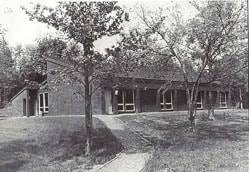
1966
In 1964, Robert Forrest of Baltimore donated 365 acres in Anne Arundel County, Maryland, to the Smithsonian Institution. The land contained a wide variety of habitats for terrestrial, wetland and estuarine field biology and ecology. The Smithsonian preserved the land as a place where scientists, local universities and government agencies could collect research specimens.
In 1966, Research Corporation granted $100,000 for the founding of the Chesapeake Bay Center for Field Biology. With this grant, along with additional funding from the Ford Foundation and five other outside funders, the Smithsonian bought 568 acres in addition to Forrest’s gift, bringing the total land area to 933 acres, and established the Chesapeake Bay Center for Field Biology.
Now known as the Smithsonian Environmental Research Center (SERC), the Center conserves natural resources, combats pollution, and educates the public. Initially focused on the Chesapeake Bay area, research at the Center is now global, with researchers viewing the Chesapeake Bay as a model for environmental issues.
Today, SERC encompasses 2,650 acres of land, and is considered the world’s leading research center for environmental studies of the coastal zone.