1939
John Vincent Atanasoff was a physicist, professor, government wartime research director and corporate research executive. While teaching at Iowa State College in the late 1930s and early 1940s, Atanasoff taught theoretical physics and conducted research in electronic digital computers. Inspired by the difficulty his students had with calculations, he invented an analog calculator for analyzing surface geometry.
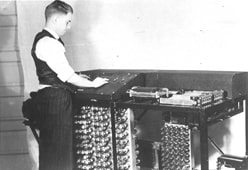
By the end of 1939, Atanasoff and graduate student Clifford Berry had created a prototype of the Atanasoff-Berry computer, which used binary math and Boolean logic to solve up to 29 simultaneous linear equations. The computer was designed as an electronic device using vacuum tubes for digital computation, and had no central processing unit.
In 1941, Atanasoff received a General Grant from Research Corporation for “mathematical research.” The following year, he left Iowa State for a wartime assignment as Chief of the Acoustic Division with the Naval Ordnance Laboratory in Washington D.C. He entrusted his patent application for the Atanasoff-Berry computer to Iowa State College administrators, but it was never filed.
In “Electronic Digital Systems,” published in 1966, author R.K. Richards noted: “The ancestry of all electronic digital computers appears to be traceable to … the Atanasoff-Berry computer.” Richards’ opinion was reinforced by the 1973 decision in the patent suit “Honeywell v. Sperry Rand” in which the 1964 patent for the ENIAC was invalidated after it was proved that the ENIAC had been derived from the Atanasoff–Berry Computer. That decision put the invention of the electronic digital computer into the public domain.
Following World War II, Atanasoff continued working for the government. In 1952 he founded and led the Ordnance Engineering Corporation, and in 1961, after he had retired, he started another company, Cybernetics Incorporated, which he operated for 20 years. Atanasoff died in 1995.